

Are recent climate changes causing wild bees to miss their floral resources? This project will investigate whether there are phenological mismatches between specialist bees and their host plants using opportunistically collected citizen sciences and museum data. The project will focus on whether the data can accurately capture changes in phenology and what are the best statistical methods to use to assess how extreme are these shifts.'
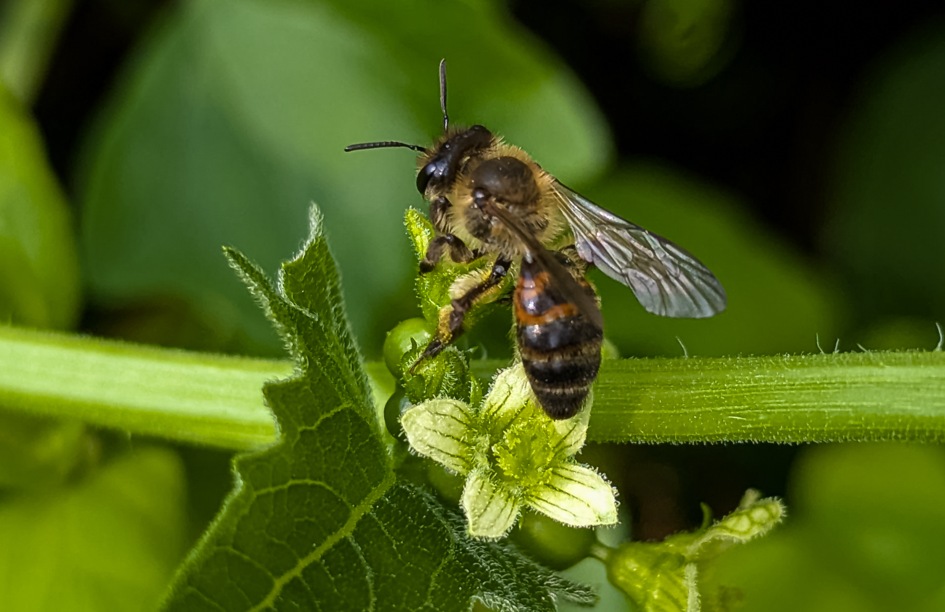
Andrena florea, a specialized Dutch wild bee visiting Brionia
Backgroundand context
Climate change can alter the seasonal timing (phenology) of ecological processes. For specialized interactions, synchrony between species emergence and resource availability is fundamental for survival. In the case of pollinators if flowers bloom too early or bees emerge too late then a ‘mismatch’ can occur.
Objectivesand goals
- Evaluate the spatial and temporal consistency of opportunistic data to ensure it is robust for trend analysis.
- Characterize the seasonal distributions (peaks, onset, duration) of specialist bees and their host plants over time.
- Test and compare different metrics to accurately represent and quantify the potential mismatch between insects and plants.
Materialsand methods
You will use long-term citizen science datasets and digitized museum records. You will filter and standardize the data to ensure spatial and temporal comparability. Using R, you will model seasonal distributions, identify peak flight and flowering times as well as first and last emergence/flowering dates. Using this output you will evaluate different metrics (e.g., mean peak overlap vs. onset divergence) to determine the most reliable method for measuring ecological mismatches.
Studentrequirements
- A strong interest in ecology, entomology, plant-insect interactions, or global change biology.
- Experience (or the desire to develop skills) in handling large datasets, statistical data analysis and programming (specifically R).
References
Bartomeus, I., Ascher, J.S., Wagner, D., Danforth, B.N., Colla, S., Kornbluth, S. and Winfree, R., 2011. Climate-associated phenological advances in bee pollinators and bee-pollinated plants. Proceedings of the National Academy of Sciences, 108(51), pp.20645-20649. https://www.pnas.org/doi/abs/10.1073/pnas.1115559108
Katal, N., Rzanny, M., Mäder, P., Römermann, C., Wittich, H.C., Boho, D., Musavi, T. and Wäldchen, J., 2023. Bridging the gap: how to adopt opportunistic plant observations for phenology monitoring. Frontiers in Plant Science, 14, p.1150956.
https://www.frontiersin.org/journals/plant-science/articles/10.3389/fpls.2023.1150956/full