

I am a computer science researcher specialising in computer vision and multimodal AI models for remote-sensing data. At Naturalis Biodiversity Center, I am a member of the Marine Biodiversity group, where I collaborate with biologists and ecologists on interdisciplinary projects focused on autonomous biodiversity monitoring in marine environments. I am also a member of the BioImaging group at Leiden University, where my research lies within computational biodiversity and focuses on integrating biological knowledge with complementary data modalities to develop more accurate, robust, and scalable methods for biodiversity monitoring. Building on the long-standing collaboration between LIACS and Naturalis, my work connects methodological advances in AI with biological expertise and real-world biodiversity-monitoring challenges.
Keywords
Biodiversity monitoring, AI, Bioimaging, Machine Learning, Multimodal Machine Learning, Nature awareness
Research interestBiology-Informed Multimodal Models for Biodiversity Monitoring
Machine learning is becoming increasingly important for biodiversity monitoring as remote-sensing devices, automated sensors, and digital collections generate unprecedented volumes of biological data. Over recent decades, biologists have collected billions of observations from natural environments, and the pace of data collection continues to accelerate as new technologies emerge. How can we analyse these data efficiently? How can we rapidly identify species and other taxonomic groups in images? And how can we uncover meaningful relationships across complementary data modalities, such as images and genomic sequences? As biodiversity changes at an increasing rate, traditional human-led analysis alone can no longer keep pace.
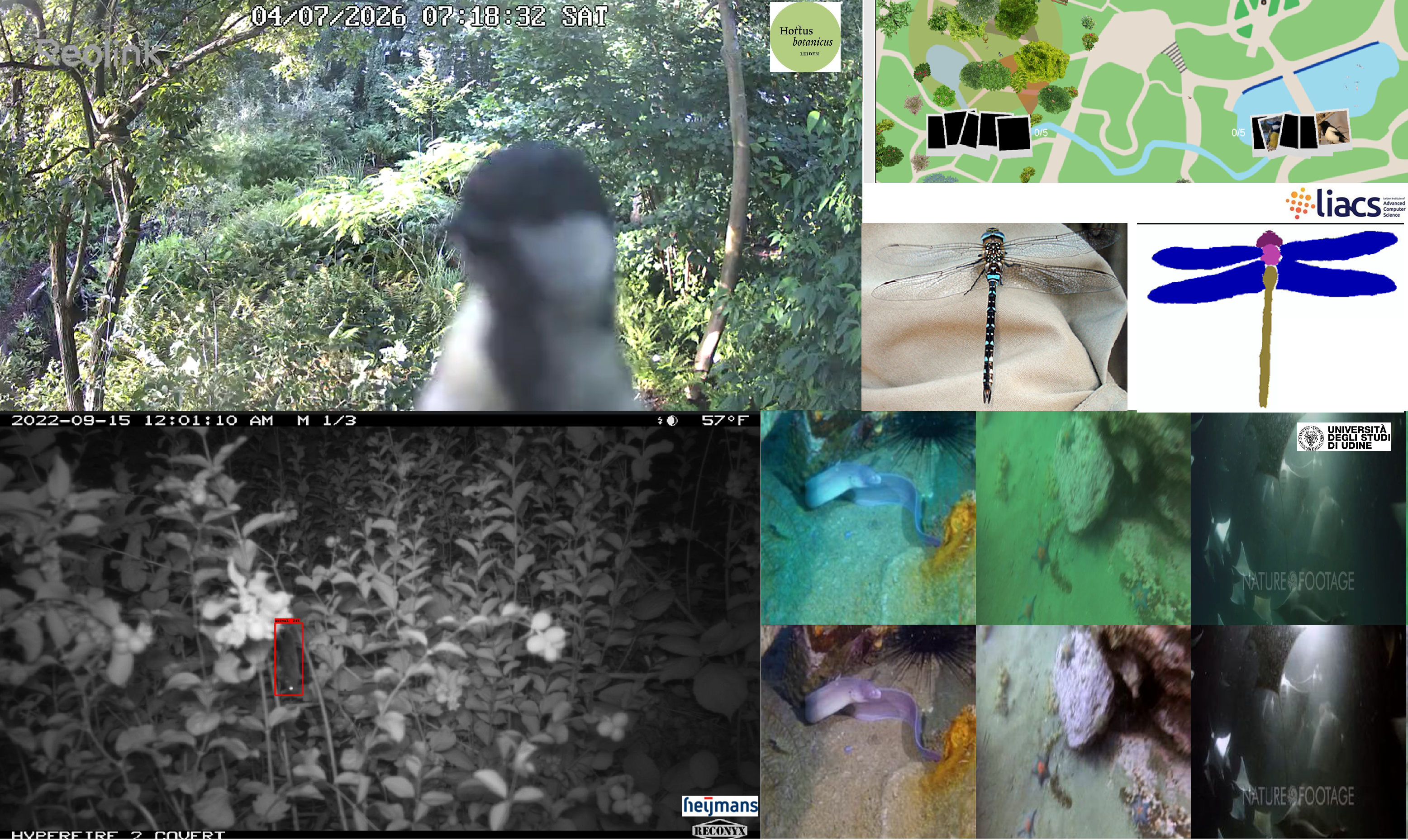
To address these challenges, I develop machine-learning methods for computational biodiversity, with a particular focus on bioimaging and multimodal data integration. My research explores models that combine images, genomic sequences, morphometric measurements and, when available, audio data to uncover cross-modal relationships, improve species identification and delimitation, and enable biodiversity monitoring at scale. I also design computer vision pipelines that use images from field surveys, museum and herbarium collections, and citizen science platforms, creating integrated tools to support biological systematics and integrative taxonomy.
Computer vision forms the methodological foundation of my research. I study how machine-learning models represent organisms and their visual characteristics in complex, non-standardised images, particularly those collected through mobile devices and citizen-science platforms. These images present challenges such as cluttered backgrounds, variable illumination, partial visibility, and large differences in viewpoint and scale.
Beyond visual recognition alone, I am interested in designing model architectures that incorporate biological knowledge, including taxonomy, morphology, and relationships among species. I also investigate how visual representations can be aligned with information from other modalities, allowing models to reason across complementary sources of biological evidence rather than treating images in isolation.
For my research, collaboration is crucial, and for this, my projects promote collaboration between Naturalis and LIACS and beyond.

Projects Current and past
TATTOOS (paTtern formATion Through biO-inspired cOmputer viSion) is a PhD project that I co-supervise with Prof. Daniele Avitabile at Vrije Universiteit Amsterdam. The project, carried out by Jens van Bijsterveld, investigates how biological knowledge encoded in mechanistic models of pattern formation can be integrated into deep neural networks. The aim is to develop biologically informed computer-vision methods that exploit the underlying processes shaping animal skin patterns and use these patterns for individual identification.
MAMBO (Modern Approaches to the Monitoring of BiOdiversity) is a research and innovation project of Horizon Europe, funded by the European Commission for 5 million euros. As part of the Horizon Europe MAMBO project, I developed and evaluated computer-vision methods for fine-grained insect species recognition from crowdsourced images. By comparing a broad range of classification approaches, this research assessed how well current models perform on challenging citizen-science data and identified their potential for scalable biodiversity monitoring.
TETTRIS Within the TETTRIs-funded TrAILSID project, I developed and evaluated a computer-vision classifier for identifying European Vertigo land-snail species from microscopy images. The project explored how AI can support the identification of small and visually similar species, making taxonomic work and biodiversity monitoring faster and more accessible. I also delivered a workshop at the Museum of Nature and Archaeology in Tenerife, introducing participants to machine-learning approaches for species recognition and their application in taxonomy.
Outreach and educational activities
INTERVIEWS AND WORKSHOPS
Exploring multimodal AI models for biodiversity: Interview on the current developments in AI for biodiversity monitoring by Ioanna Lykiardopoulou
Workshop: "AI and machine learning in biodiversity monitoring" on January 29th 2026 at Sorbonne University in Paris, France.
Workshop: "Using Artificial Intelligence for the Determination of Land Snails from Tenerife" on 23rd–25th September 2025 at Museo de Naturaleza y Arqueología in Santa Cruz de Tenerife, Spain
Episode 20: Rita Pucci: Reading the stripes, AI meets wildlife: "What’s the difference between a zebra and a zebrafish? Assistant professor Rita Pucci, who works at both LIACS and Naturalis, brings together biodiversity and computer science. She’s developing a model that can recognise unique skin patterns of individual animals within a herd: a breakthrough that could transform how wildlife is monitored." from Podcast Computers don't byte by Michiel van Poelgeest, Dimitra Kouimtzidou, Marcel Tichelaar
EDUCATION AND TEACHING
Multimodal Models for Ecology and Biodiversity at Leiden University in the Leiden Institute of Advanced Computer Science. The course is meant for Master's students in Computer Science with specialisation in BioInformatics, Computer Science, and Data Science. This course introduces the fundamentals of multimodal models and their application to ecology and biodiversity monitoring. It focuses on leveraging heterogeneous data, such as images, audio, and biological measurements, to enhance the performance of automated monitoring systems. Key topics include the design, integration, and analysis of the components of multimodal machine learning models.
Keypublications
- Niki Martinel, Rita Pucci. Physics Informed Capsule Enhanced Variational AutoEncoder for Underwater Image Enhancement, arxiv 2025
- Rita Pucci, Niki Martinel. Ce-vae: capsule enhanced variational autoencoder for underwater image enhancement, 2025 IEEE/CVF winter conference on applications of computer vision (WACV)
- Rita Pucci, Vincent J Kalkman, Dan Stowell, Performance of computer vision algorithms for fine‐grained classification using crowdsourced insect images, IET Computer Vision 19 (1), e700067, 2025
- L Hogeweg, N Yan, D Brunink, K Ezzaki-Chokri, W Gerritsen, Rita Pucci, et al., AI species identification using image and sound recognition for citizen science, collection management and biomonitoring: From training pipeline to large-scale models. Biodiversity Information Science and Standards 8, 6, 2024
- Rita Pucci, Christian Micheloni, Niki Martinel. Pro-CCaps: Progressively Teaching Colourisation to Capsules. Proceedings of the IEEE/CVF Winter Conference on Applications of Computer Vision (WACV), 2022, pp. 2271-2279
- Rita Pucci, Christian Micheloni, Niki Martinel. CVGAN: Image Generation with Capsule Vector-VAE. International Conference on IMAGE ANALYSIS AND PROCESSING (ICIAP), 2022, pp 536–547
- Rita Pucci, Christian Micheloni, Niki Martinel. Self-Attention Agreement Among Capsules, Proceedings of the IEEE/CVF International Conference on Computer Vision (ICCV) Workshops, 2021, pp. 272-280
- Rita Pucci, Christian Micheloni, Niki Martinel. Collaborative Image and Object Level Features for Image Colourisation. Proceedings of the IEEE/CVF Conference on Computer Vision and Pattern Recognition (CVPR) workshops, 2021, pp. 2160-2169