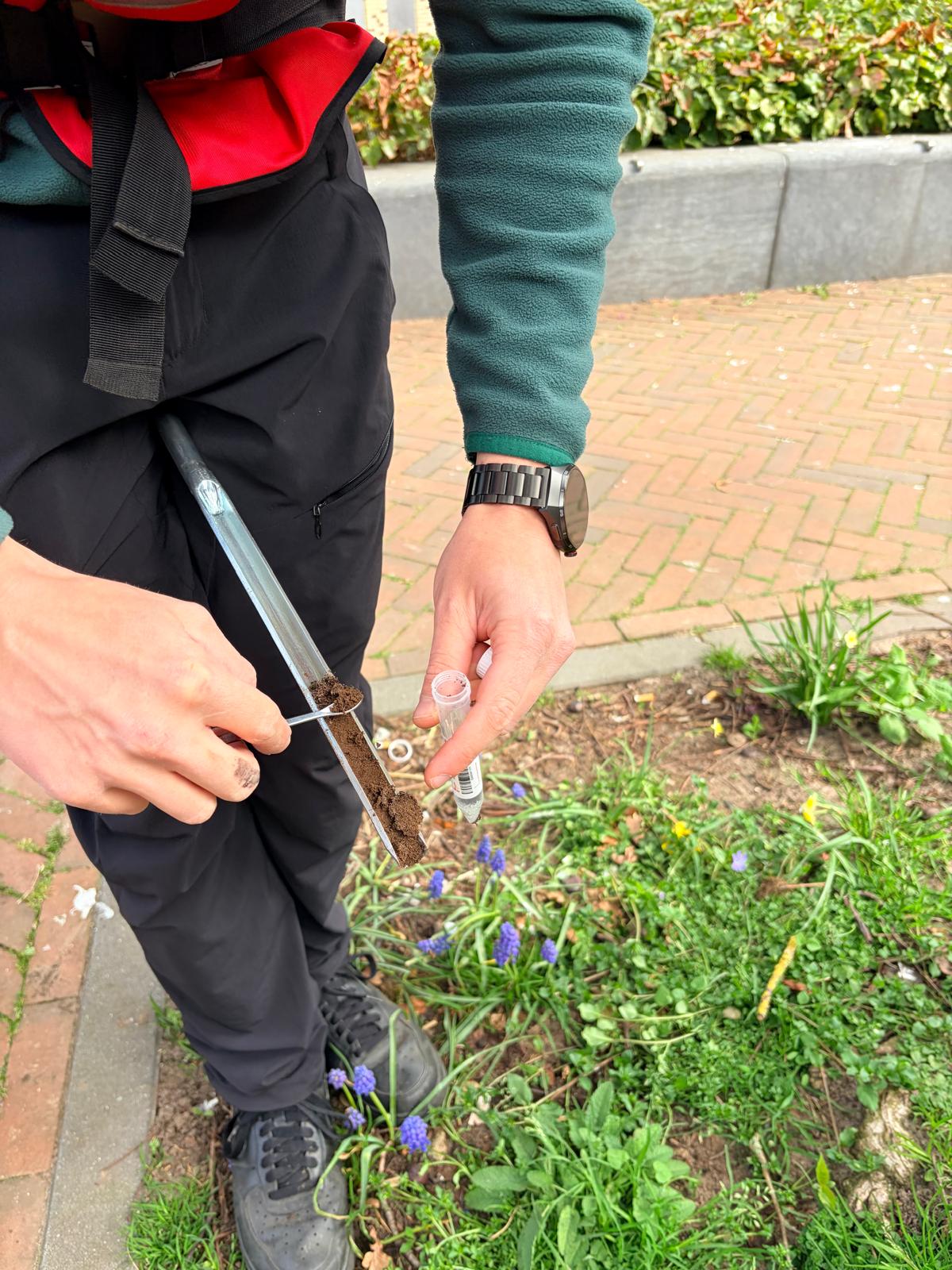

My research focuses on mapping the biodiversity in urban soils around trees to better understand its role in the vitality of urban trees. This insight is essential for achieving “soil-smart” and climate-resilient urban greening. As part of the Thirsty Cities project, the focus is on the impact of abiotic factors, such as drought and the urban heat island effect, on microbial community composition. To investigate this further, DNA is extracted from soil samples around these trees and sequenced using the eDentity infrastructure, resulting in species lists (ASV tables) of fungi, bacteria, invertebrates, and other eukaryotic soil organisms. The relative impact of drought and the functional identity of the tree on urban microbial soil communities is then investigated using models.
Key words
Metabarcoding, eDNA, soil biodiversity, urban ecology, drought, trees
Research
On March 23, 2026, I began sampling in Amsterdam, the first of the nine “Thirsty Cities.” In each city, soil samples are taken from tree pits and parks around five different tree species. Each of these tree species differs in the type of symbiosis they form with soil organisms, as well as in how drought-sensitive or drought-resistant they are.
Using the urban heat island effect map, I divide the city into three categories to also account for the influence of an urbanization and drought gradient. In each “heat category”, I take soil samples from five tree pits per tree species. Soil samples are also taken around five trees of each species in parks to study the differences in soil biodiversity between tree pits and parks.
This results in 100 locations per city that will be sampled according to the eDentity protocol, amounting to an estimated 3,500 soil samples for DNA analysis and 900 for soil analysis.